Showing posts with label How to. Show all posts
Showing posts with label How to. Show all posts
Friday, July 30, 2010

8:56 AM | Posted by
Donovan Banks |
 Edit Post
 Edit Post
When playing small gigs one encounters a variety of very strange people. It’s not always drunk people either. I will try list those I have come across and how to handle them professionally.
The Starer – This is the person who saunters up really close to where you are playing and tries to take in everything without blinking. He/She will walk slowly back and forth across the front of the stage, or round the sides too if it is clear and will glare at every piece of gear on the stage. They only glance at you; the musician and try avoid eye contact. They may get a blank look on their face and their mouth may start to fall open. This is not a sign of awe but more a sign of complete brain shut down. The Starer is harmless but needs to be watched in case they turn out to be a crazy fanatic who thinks you are Elvis reincarnated and is looking for a souvenir to snatch and run away with. Keep an eye on this one.
The Drunk Dancer – This one may appear to be really enjoying the music and embarrassing themselves on the dance floor. They do provide the band with some entertainment as well but may easily turn into the requester or the wannabe-member. Look, smile and enjoy the person who is enjoying you making music.
The Requester – This is the person who hangs around one of the members mid song. They usually target the most accessible, or the most accessible looking member. As the song finishes they pounce and make a request for Elvis, the Beatles, Dire Straits or Wonderful Tonight. If you can fulfill the request then do so if you wish. Always be polite but if they request something you hate playing, ask for all requests to be written on a R200 note. This generally gets them to leave you alone but it may just score you an extra R200.
The Visiting Muso – To me these can be either really encouraging or a massive pain in the butt. He tends to stand somewhere he thinks is inconspicuous but you can spot him a mile away. He stands leaned against a wall or railing with his hands in his pockets or arms folded. He will watch the member who plays the same instrument as him. One has to particularly worry when this one is part requester. He has the potential to approach a member and request the song he finds most difficult to play. When you say no, he will retort with, “Oh, I can play that.” Or, “Real musicians don’t need sheet music.” Or some snide remarks that will make you want to moer him with your instrument. If you are a musician watching a band, smile. Look approachable and happy to be watching the band. Remember the person on stage is just like you and could use encouragement and positive reinforcement whether they are better or worse than you.
The Wannabe Member – She is the person who wants to sing a song. Part requester and usually inebriated this person suddenly gets the courage and talent and wants to be part of your band. My view is to not oblige these people. Politely say, “We have a rehearsed system and we’ll only make you look bad.” Or something else nice but firm. If you do allow them on stage, they could either be really bad in which case you have potentially made the most popular person in the bar look stupid making a few enemies, or they could be really good and make you look bad.
The Interrupter – The interrupter is usually one of the above but with no manners. They will approach a band member mid song, yes, while you are playing or singing and want to engage you in conversation. I have lost count how many times this has happened to me. This is a result of trying to interact with your audience. If you sense he is about to approach you employ the cold shoulder, if you are standing. The Cold Shoulder is deployed by turning your back on the person. If they approach you from behind they will have to make physical contact now which is unlikely. If you are sitting, then the death stare should help but is not very effective. You’re on your own.

Wednesday, May 19, 2010
3:59 PM | Posted by
Donovan Banks |
Edit Post
Edit Post
I used to always have my amp standing on the floor when I played. I battled to get my sound right for ages.
What was happening was that the majority of the sound was hanging out on the floor, and what was coming to my ears was only certain frequencies, mainly higher tones.
So I got an amp stand and now I aim the amp at me, much like a monitor.

What was happening was that the majority of the sound was hanging out on the floor, and what was coming to my ears was only certain frequencies, mainly higher tones.
So I got an amp stand and now I aim the amp at me, much like a monitor.

Now I am hearing the full effect of the amp, all the tones of my guitar and if I mic it up right, so should the audience. See my Vox on the left.
The next problem comes in with what I had to deal with this week. I played on someone else's amp twice this week, once on Sunday and then again this morning, 19 May 2010. The difference it made as to where the amp was placed is huge.
Sunday I played on a small Fender combo amp. It was placed on a chair right behind me. The stage was small and tight and I was battling to stop any feedback. The amp and guitar were way too close together and as soon as I added any gain for lead sounds, it was uncontrollable. But, because I was in a rush and it wasn't my stage I couldn't change it around. Without gain it was fine, but very loud and it made me uncomfortable. When you sound good, your attitude comes right and then you play better. When you sound bad you focus too much on it and try to fix your sound instead of actually playing.
This morning I played on a Roland JC120. The stage was much bigger and the amp was far away from me, pointing up at me again. When I added the lead patch on my GT8, no feedback, no uncomfortable noise, just pure goodness.
It is very important to take time and find your position for your amp and you. You don't want the amp pointing at the guitar, you will just get feedback. You don't want it aimed parallel to the floor, unless you have ears in your ankles. You want the amp aimed at your head so you can hear it clearly, sound good, and rock out properly.
 Labels:
advice,
Boss GT8,
Gear,
How to,
live,
performance,
Roland,
Sound engineer,
technical
|
Labels:
advice,
Boss GT8,
Gear,
How to,
live,
performance,
Roland,
Sound engineer,
technical
|
 0
comments
0
comments
Thursday, April 29, 2010
11:23 AM | Posted by
Donovan Banks |
Edit Post
Edit Post
I purchased a set off books recently that I think I should tell you about. They are a short series by David Mead and while I cannot vouch for the author, nor the accuracy of the content in the book, I always feel that if I learn one thing that improves my playing or attitude, then it is worth it.
I have the Basic Scales for Guitar, Basic Chords for Guitar, Basic Kit Repair and the Basic Guitar Workout.
Now I am very impressed with the Guitar Workout as it gives you some very good practice techniques which are very important.
The book works on a simple principle that 10 minutes of good practice here and there is better than not practicing because you only have 10 minutes. How he structures the sessions is that you randomly open the book to any exercise, and spend 2 minutes doing it. He gives a guide on how many repetitions you should be able to achieve in those 2 minutes but the aim is to do as many as you can, while maintaining clear tones.
Some of the exercises are rather tricky though he has split them into three categories, Warm-up; Co-ordination; and Ear Training. They really work your fingers and force you to practice real techniques that matter, not just speed but clarity across all available fingers.
I do like to buy little things like this. My main aim is to learn as much as possible, from all sources possible. That was my first and biggest lesson.
I have the Basic Scales for Guitar, Basic Chords for Guitar, Basic Kit Repair and the Basic Guitar Workout.
Now I am very impressed with the Guitar Workout as it gives you some very good practice techniques which are very important.
The book works on a simple principle that 10 minutes of good practice here and there is better than not practicing because you only have 10 minutes. How he structures the sessions is that you randomly open the book to any exercise, and spend 2 minutes doing it. He gives a guide on how many repetitions you should be able to achieve in those 2 minutes but the aim is to do as many as you can, while maintaining clear tones.
Some of the exercises are rather tricky though he has split them into three categories, Warm-up; Co-ordination; and Ear Training. They really work your fingers and force you to practice real techniques that matter, not just speed but clarity across all available fingers.
I do like to buy little things like this. My main aim is to learn as much as possible, from all sources possible. That was my first and biggest lesson.
Friday, March 12, 2010
10:45 AM | Posted by
Donovan Banks |
Edit Post
Edit Post
I got a question from one of the vids on YouTube
"How do you record onto v-track 78_2 and delete the one that's already there?"
To select where to bounce the track move your cursor to the top right of the screen. You will see this;
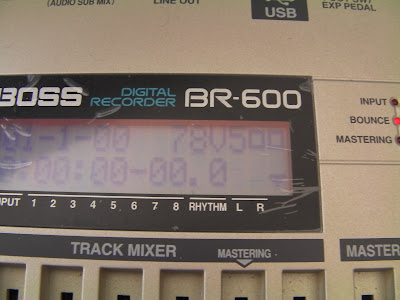
Select which track by using the scroll wheel, then select which V-Track you wish to use. This is currently track 7/8, V-track 5.
The squares next to the number indicate whether you have something recorded there or not. If they are blank then no data is recorded in the V-Track
Hope That helps. Feel free to ask anything else.
"How do you record onto v-track 78_2 and delete the one that's already there?"
To select where to bounce the track move your cursor to the top right of the screen. You will see this;
Select which track by using the scroll wheel, then select which V-Track you wish to use. This is currently track 7/8, V-track 5.
The squares next to the number indicate whether you have something recorded there or not. If they are blank then no data is recorded in the V-Track
Hope That helps. Feel free to ask anything else.
Thursday, February 18, 2010
8:33 AM | Posted by
Donovan Banks |
Edit Post
Edit Post
I never really liked the flying V so I advertised it for sale and I was traded a Samick strat style guitar for it. Value wise I reckon they're pretty much the same but the Epiphone has a more popular brand name. The Samick is a basic strat style guitar with two humbucking pickups and a floating Tremolo bridge.
I didn't really find time to play with the guitar much but when I did,
 I found the D-string almost jumped out every time I used the trem. The guide at the bridge was broken and couldn't be held in place.
I obtained a new bridge hoping to just slot it in, but the plate was smaller than the current trem and it certainly wasn't going to be that easy. The next thing I thought I could do was to swop out all the guides.
 The new bridge also had smaller screws to adjust the intonation which meant the gap in the "fork" was too smal for the screws in the existing bridge, and the small screws were too small for the holes in the old bridge as well.
 This is the broken guide and the new one I put in. There are some very cool differences. The new guide is a string through, meaning I don't have to cut the ball end off to re-string. Although it doesn't have individual height adjusters like the old guides. I'm lucky the neck is fairly flat so it doesnt matter all that much.


 There it is all done. The intonation, luckily, was spot on when I put the bridge on. The hardest part is adjusting the spring for the trem vs. the string gauge. Thankfully I've done that before and it was easier. It has a fatter neck than I thought it would but it plays very smooth and I can see myself enjoying it for a short while before selling it off.
I didn't really find time to play with the guitar much but when I did,

I obtained a new bridge hoping to just slot it in, but the plate was smaller than the current trem and it certainly wasn't going to be that easy. The next thing I thought I could do was to swop out all the guides.
 The new bridge also had smaller screws to adjust the intonation which meant the gap in the "fork" was too smal for the screws in the existing bridge, and the small screws were too small for the holes in the old bridge as well.
 This is the broken guide and the new one I put in. There are some very cool differences. The new guide is a string through, meaning I don't have to cut the ball end off to re-string. Although it doesn't have individual height adjusters like the old guides. I'm lucky the neck is fairly flat so it doesnt matter all that much.
Filed out to make it wider.

I filed the top down as well to give the screw more bridge to bite on. With the current height of that guide it only had less than 1mm to grip and I felt it could use more, especially at the tension and use I intend putting it through.

Thankfully this won't make a difference to the action or feel of the guitar. It made more mechanical sense to do this.

There's the bridge all together now.

Here you can see where the strings are threaded. It definitely makes restringing much easier.

I'm GASsing for an Ibanez S Series... mmmmm
Friday, January 29, 2010
9:04 AM | Posted by
Donovan Banks |
Edit Post
Edit Post
2 Years ago I had a 70's Fender Bassman in fair condition but it was looking tatty. I undertook to re-cover it in white vinyl. It was a wonderful sounding amp but it was too big for me to haul around so I sold it.
This is how it looked before. That speaker was from another old valve amp that died.


It was quite old looking and had a fair amount of damage to the tolex


I set about removing the old tolex from the head

and cleaned off the remaining glue

I used the pieces I took off to cut the new vinyl and used contact glue to stick it on.


I covered the front face with the only black fabric I could find at the time using staples

After cleaning up the metal trimming I assembled it again when the glue was good and dry


The Cabinet had water damage (have no idea from where) and it was made out of chipboard. When I tried to remove the tolex it just disintegrated. I bought some pine and made a new cabinet using the same face and back board but I put castors on it this time to make transport easier....
I also covered the cabinet in the same vinyl and black face cloth


It turned out much better and even made my guitar look cooler....

I had a good time with this project and I intend to do it again some time, although not with a new amp, I'll find another old one.
This is how it looked before. That speaker was from another old valve amp that died.
It was quite old looking and had a fair amount of damage to the tolex
I set about removing the old tolex from the head
and cleaned off the remaining glue
I used the pieces I took off to cut the new vinyl and used contact glue to stick it on.
I covered the front face with the only black fabric I could find at the time using staples
After cleaning up the metal trimming I assembled it again when the glue was good and dry
The Cabinet had water damage (have no idea from where) and it was made out of chipboard. When I tried to remove the tolex it just disintegrated. I bought some pine and made a new cabinet using the same face and back board but I put castors on it this time to make transport easier....
I also covered the cabinet in the same vinyl and black face cloth
It turned out much better and even made my guitar look cooler....
I had a good time with this project and I intend to do it again some time, although not with a new amp, I'll find another old one.
Monday, December 7, 2009
9:05 AM | Posted by
Donovan Banks |
Edit Post
Edit Post
Basically I pan two tracks left and right to make it feel like a wall, but here are the videos...
Enjoy.
Please feel free to comment and also take some time to visit the sponsors of this blog...
Enjoy.
Please feel free to comment and also take some time to visit the sponsors of this blog...
Wednesday, December 2, 2009
9:12 AM | Posted by
Donovan Banks |
Edit Post
Edit Post
A short Video Demo on how to Export Tracks using the BOSS BR600
Monday, November 30, 2009
10:07 PM | Posted by
Donovan Banks |
Edit Post
Edit Post
I know a few people battle with this so I put together this video on putting together rhythm arrangements for the BR600. I know the concept is the same for the Micro BR so knock yourself out.
The Song sheet can be found here...
The Song sheet can be found here...
Tuesday, November 17, 2009
1:08 PM | Posted by
Donovan Banks |
Edit Post
Edit Post
I notice so many YouTube videos with sub standard audio. The audio on my videos aren't great, but if I were to use the camera audio as my main audio it would be terrible. As with everything you need to edit and clean things up a bit.
If I talk I use the camera audio. I will be getting a lapel microphone soon so that will be clearer as well but for now I just use the camera.
For the guitar I mainly run into my Boss GT8, then into a small mixing desk and into my Computer.

I use Samplitude 10 as my DAW (Digital Audio Workstation) and Magix Movie Edit Pro 15 as my video editing software.
recording the guitar separate gives me a great clean way to record without external noise influence such as the size of my room etc, so you hear the guitar clearly.
Take a look at my channel and see for yourself.
If I talk I use the camera audio. I will be getting a lapel microphone soon so that will be clearer as well but for now I just use the camera.
For the guitar I mainly run into my Boss GT8, then into a small mixing desk and into my Computer.
I use Samplitude 10 as my DAW (Digital Audio Workstation) and Magix Movie Edit Pro 15 as my video editing software.
recording the guitar separate gives me a great clean way to record without external noise influence such as the size of my room etc, so you hear the guitar clearly.
Take a look at my channel and see for yourself.
Friday, October 30, 2009
3:45 PM | Posted by
Donovan Banks |
Edit Post
Edit Post
I got a Fender Jeff Beck Hot Noiseless pickup for a Strat. Its supposed to be a hotter pup with more gain and stronger tone.
The result is fantastic and I also changed the look slightly of my guitar.
Before

After

I need to find a cover that fits the HN.
Inside before

Inside After

Tonally it sounds very cool. I made a video of that as well,
The result is fantastic and I also changed the look slightly of my guitar.
Before
After
I need to find a cover that fits the HN.
Inside before
Inside After
Tonally it sounds very cool. I made a video of that as well,
Monday, July 20, 2009
11:03 AM | Posted by
Donovan Banks |
Edit Post
Edit Post
This weekend I played at the Awakening as part of Nelisa Kala's band. We've been working for a few weeks to put together this show (hence the quiet blog).
We have a good band with very talented musicians, Keith Naidoo on guitar, Lazarus Pillay on Keys and Ross Viljoen on Drums.
We had some issues that we could learn from this weekend.
Friday: We arrived to do a sound check to discover they had a 6 channel sound desk with 2 monitor sends, they had no monitors and their equipment was shocking. One would normally expect a theatre to have top level sound systems and be well equipped for anything. We took it for granted that the venue provided what they said they would. As a result we had to fix it by borrowing equipment and using a separate feed as monitors and to try boost the quality of the house sound.
Saturday: The gig went very well. Keith played outstanding solo's and people loved it. Nelisa did something amazing in that she forgot the words to one of her poems but she covered it so well and nobody was the wiser. Being a professional is not about never making mistakes, it's about being able to handle them. The crowd LOVED the way she did so that night. She was brilliant and it showed in the audience reaction.
Sunday: we had a substantially smaller crowd. We were comfortable with the venue and sound by now so we were set to have a smooth gig. Keith had issues with his pedal which was buzzing badly every time he tried to change effects. This, of course, happened mid song. There are a few learning points here that we can look at.
Keep an eye out for Nelisa Kala and the Awakening. We'll be doing the rounds soon enough and it is something definitely worth watching.
We have a good band with very talented musicians, Keith Naidoo on guitar, Lazarus Pillay on Keys and Ross Viljoen on Drums.
We had some issues that we could learn from this weekend.
Friday: We arrived to do a sound check to discover they had a 6 channel sound desk with 2 monitor sends, they had no monitors and their equipment was shocking. One would normally expect a theatre to have top level sound systems and be well equipped for anything. We took it for granted that the venue provided what they said they would. As a result we had to fix it by borrowing equipment and using a separate feed as monitors and to try boost the quality of the house sound.
Saturday: The gig went very well. Keith played outstanding solo's and people loved it. Nelisa did something amazing in that she forgot the words to one of her poems but she covered it so well and nobody was the wiser. Being a professional is not about never making mistakes, it's about being able to handle them. The crowd LOVED the way she did so that night. She was brilliant and it showed in the audience reaction.
Sunday: we had a substantially smaller crowd. We were comfortable with the venue and sound by now so we were set to have a smooth gig. Keith had issues with his pedal which was buzzing badly every time he tried to change effects. This, of course, happened mid song. There are a few learning points here that we can look at.
- check your gear before you play. If there are any problems that can't be fixed, and if there is a chance it would happen in the set, remove it and make do. A clean guitar solo can be just as effective as an over driven one. It is also impressive at times to see just raw guitaring. While effects can add to the ambiance, as long as your guitar works you are able to play.
- Nelisa had walked over to the opposite side of the stage to give Keith focus at his solo time. That's when his gear failed so he could do nothing. She could have turned her focus to either the keys or even the bass to fill in the solo gap. Take the focus off the problem and get the audience looking somewhere else so the problem can be sorted out on the side.
- When a lead guitarists gear fails on him, there is obviously a big gap. Other guitarists in the band should be able to cover the empty space. Again, get the focus off the problem so it can be handled quickly. If not another guitarist, the keys, bass or even drums can sort it out. You should generate a good enough feel for each other so you know who will step in if something goes wrong.
Keep an eye out for Nelisa Kala and the Awakening. We'll be doing the rounds soon enough and it is something definitely worth watching.
Subscribe to:
Posts (Atom)
About Me
- Donovan Banks
- Durban, KZN, South Africa
- I am a musician who does anything and everything else. I write about what I do and how I do it. Enjoy and feel free to comment.
Subscribe To


 Posts
All Comments
Posts
All Comments